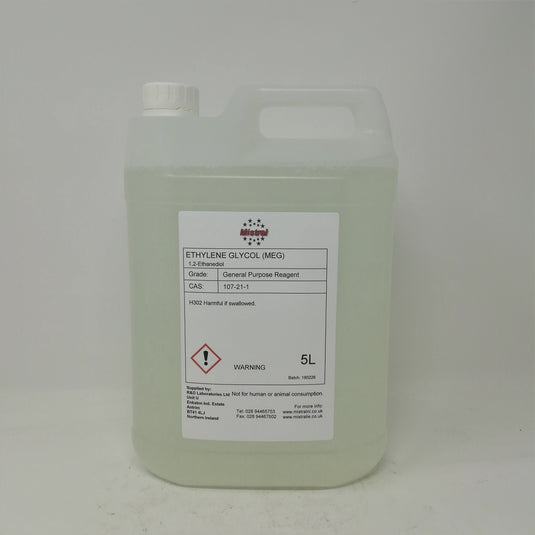
MONOETHYLENE GLYCOL
Technical grade 99.3%
Monoethylene glycol (MEG) is an organic compound widely used as an antifreeze for the automotive trade and a precursor to polymers. In its pure form, it is an odourless, colourless, hygroscopic, low-viscosity liquid. It is completely miscible with water in all proportions. The diverse chemistry of ethylene glycol allows it to be used in the laboratory or in industry for a wide range of reactions.
MEG as a coolant and heat transfer agentThe major use of ethylene glycol is as a medium for convective heat transfer in, for example, cars and liquid cooled computers. Ethylene glycol is also commonly used in chilled water air conditioning systems that place either the chiller or air handlers outside, or systems that must cool below the freezing temperature of water. In geothermal heating/cooling systems, ethylene glycol is the liquid that transports heat through the use of a geothermal heat pump.
Due to its low freezing point ethylene glycol resists freezing. The freezing point of a mixture of 60% ethylene glycol and 40% water freezes below -45 oC. It is used as a deicing fluid for windscreens and aircraft.
Ethylene glycol freezing point vs. concentration in water
| Weight Percent MEG (%) | Freezing Point (deg C) |
|---|---|
| 0 | 0 |
| 10 | -4 |
| 20 | -7 |
| 30 | -15 |
| 40 | -23 |
| 50 | -34 |
| 60 | -48 |
| 70 | -51 |
| 80 | -45 |
| 90 | -29 |
| 100 | -12 |
MEG as a drying agent / Desiccant
Because of its high boiling point and affinity for water, ethylene glycol is a useful desiccant.
Instead of removing water, ethylene glycol can also be used to depress the temperature at which hydrates are formed. The purity of glycol used for hydrate suppression (mono-ethylene glycol) is typically around 80%, whereas the purity of glycol used for dehydration (tri-ethylene glycol) is typically 95-99+%. Moreover, the injection rate for hydrate suppression is much lower than the circulation rate in a glycol dehydration tower.
Other applications for MEG
- As an additive to prevent corrosion in liquid cooling systems for computers
- In the manufacture of some vaccines
- It is used as a minor ingredient in shoe polish and also in some inks and dyes.
- Ethylene glycol has seen some use as a rot and fungal treatment for wood, both as a preventative and a treatment. Often it is used as a carrier for boric acid and borax in woodworm treatments and wet/dry rot treatments.
- Mixed with isopropyl alcohol it is used for cleaning mirrors, glass, lenses and screens.
- Ethylene glycol is commonly used as a preservative for specimens in schools during dissection.
Properties of MEG
- Synonyms: Ethane-1,2-diol; 1,2-Ethanediol; Glycol; Ethylene Alcohol; Hypodicarbonous acid; Monoethylene glycol;
- CAS NO: 107-21-1
- EINECS: 203-473-3
- Mol formula: C2H6O2
- Mol mass: 62.07 g/mol
- Appearance: clear liquid
- Colour: <10 pt-co="" li="">
- Distillation BP: 197oC
- Melting point: -12.9oC
- Flash Point: 111oC
- Autoignition temperature: 410oC
Health & Safety:
HARMFUL
R22- Harmful if swallowed.
S2- Keep out of the reach of children.
PLEASE NOTE: This product is not for human or animal consumption.
Click here to view sales specification sheet